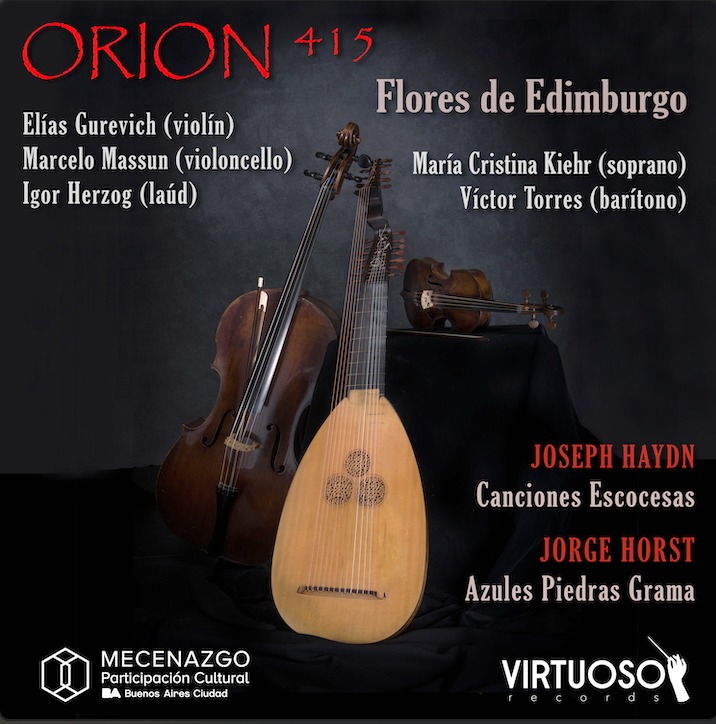
FLORES DE EDIMBURGO
Las canciones escocesas de Joseph Haydn nacieron de un encuentro singular: el de unas
melodías transmitidas y transformadas a través del tiempo con la sensibilidad musical de uno
de los grandes compositores de la Europa del siglo XVIII.
Cuando Haydn trabajó sobre ellas, estas melodías ya llegaban cargadas de historia. Habían
pasado de una voz a otra, de un instrumento a otro, de una generación a la siguiente. Los
editores ingleses que las reunieron a fines del siglo XVIII intentaron recuperar aquello que
consideraban sus formas más antiguas, apartándolas de adornos y modificaciones que
juzgaban posteriores. Al mismo tiempo, reconocían la dificultad de armonizar aquellas melodías
sin alterar su carácter y encontraron en Haydn al compositor capaz de darles una nueva
dimensión.
Pero estas primeras ediciones son también documentos de una época en la que el interés por
lo antiguo, lo nacional y lo auténtico comenzaba a convertirse en un poderoso valor cultural y
comercial. Sus prólogos y disertaciones construyen una historia de la música escocesa en la
que conviven observaciones musicales, tradiciones, hipótesis y afirmaciones que hoy no
siempre pueden sostenerse como hechos. El propio discurso editorial deja entrever esa mezcla:
se habla de buscar las melodías originales «hasta donde puedan ser determinadas», mientras
se formulan al mismo tiempo interpretaciones históricas de carácter marcadamente conjetural.
Algo semejante sucede con los textos. Los editores reconocían abiertamente que algunos de
los poemas originales habían sido sustituidos por otros considerados más apropiados para la
publicación. La canción que escuchamos, por lo tanto, no es necesariamente el testimonio
intacto de un pasado remoto, sino el resultado de una larga cadena de transformaciones:
tradición oral, transmisión musical, selección editorial, nuevos textos y, finalmente, la escritura
armónica de Haydn.
Una edición alemana publicada en Leipzig en 1803 llevaría aún más lejos la afirmación de
autenticidad, presentando las melodías como «auténticas y antiguas» y señalando que Haydn
había compuesto para ellas la armonía. Allí se recuerda además que las versiones originales
estaban destinadas a violín y bajo cifrado, antes de ser adaptadas para piano. En realidad, la
edición inglesa se destaca por su escritura mixta: el acompañamiento contiene a su vez
elementos de bajo continuo y figuras netamente pianisticas. Esto, junto con el formato de la
impresión (ninguna canción supera a una página, y sobre la hoja enfrente figura el texto
completo) lo hace un objeto típico de la Hausmusik, música que puede ser ejecutada de varias
maneras con participación de toda la familia.
Entre esas afirmaciones históricas y la música que ha llegado hasta nosotros queda, sin
embargo, un territorio mucho más interesante: el de la imaginación.
Porque acaso sea imposible determinar con absoluta certeza qué parte de cada melodía
pertenece a un pasado remoto y qué parte fue modificada por quienes la transmitieron. Lo que
sí podemos escuchar es su capacidad de sobrevivir a esas transformaciones. Haydn no las
contempla como piezas arqueológicas: las escucha, las comprende y las convierte en música
nueva. Su armonización no borra su singularidad; establece con ellas un diálogo.
Flores de Edimburgo propone volver a ese diálogo.
Las canciones escocesas aparecen aquí no como reliquias, sino como formas vivas, capaces
de atravesar siglos y volver a adquirir significado cada vez que alguien las canta. En ellas
conviven la memoria y la invención, lo popular y lo elaborado, lo anónimo y la mano de un
compositor cuya escritura transforma profundamente aquello que recibe.
Y es precisamente en ese punto donde el pasado encuentra al presente.
El disco se completa con Azules Piedras Grama, del compositor argentino Jorge Horst, una
obra contemporánea inspirada en las canciones de Haydn. Su presencia no pretende ilustrar ni
prolongar históricamente el repertorio anterior. Funciona, más bien, como un cambio de
perspectiva: las mismas resonancias que alguna vez atravesaron la música escocesa vuelven a
ser escuchadas desde otro tiempo, otro lugar y otra sensibilidad.
Así, entre las canciones de una tradición lejana y la creación de un compositor argentino de
nuestro tiempo, se establece una distancia de siglos que es también una proximidad. El pasado
deja de ser una imagen inmóvil y se convierte nuevamente en materia sonora.
Tal vez sea eso lo que estas flores conservan: no una procedencia perfectamente determinada,
sino la capacidad de florecer otra vez.
Maria Cristina Kiehr — soprano
Víctor Torres — barítono
Elías Gurevich — violín
Marcelo Massun — violoncello
Igor Herzog — laúd
Joseph Haydn — Canciones escocesas
Jorge Horst — Azules Piedras Grama
FLOWERS OF EDINBURGH
Joseph Haydn’s Scottish songs were born from a unique encounter: that melodies transmitted and transformed through time with the musical sensibility of one of the great composers of 18th-century Europe.
When Haydn worked on them, these melodies were already laden with history. They had passed from one voice to another, from one instrument to another, from one generation to the next. The English publishers who gathered them at the end of the 18th century sought to recover what they considered to be their most ancient forms, stripping them of ornaments and modifications they deemed later additions. At the same time, they recognized the difficulty of harmonizing those melodies without altering their character and found in Haydn the composer capable of giving them a new dimension.
Yet these early editions are also documents of an era in which interest in the ancient, the national, and the authentic was beginning to turn into a powerful cultural and commercial value. Their prologues and dissertations construct a history of Scottish music in which musical observations, traditions, hypotheses, and assertions that today cannot always be sustained as facts coexist. The editorial discourse itself hints at this mixture: it speaks of seeking out the original melodies "to the extent that they can be determined," while simultaneously formulating historical interpretations of a markedly conjectural nature.
Something similar happens with the texts. The publishers openly acknowledged that some of the original poems had been replaced by others deemed more appropriate for publication. The song we hear, therefore, is not necessarily the intact testimony of a remote past, but the result of a long chain of transformations: verbal tradition, musical transmission, editorial selection, new texts, and finally, Haydn's harmonic writing.
A German edition published in Leipzig in 1803 would push the claim of authenticity even further, presenting the melodies as "authentic and ancient" and noting that Haydn had composed the harmony for them. It also recalls that the original versions were intended for violin and figured bass, before being adapted for the piano. In reality, the English edition stands out for its mixed writing: the accompaniment contains elements of both basso continuo and clearly pianistic figures. This, alongside the print format (no song exceeds a single page, with the full text appearing on the facing page), makes it a quintessential object of Hausmusik—music that could be performed in various ways with the participation of the whole family.
Between those historical claims and the music that has reached us lies, however, a much more interesting territory: that of the imagination.
For it may be impossible to determine with absolute certainty what part of each melody belongs to a remote past and what part was modified by those who transmitted it. What we can indeed hear is its capacity to survive those transformations. Haydn does not view them as archaeological pieces: he listens to them, understands them, and turns them into new music. His harmonization does not erase their singularity; it establishes a dialogue with them.
Flowers of Edinburgh proposes a return to that dialogue.
The Scottish songs appear here not as relics, but as living forms, capable of crossing centuries and acquiring new meaning every time someone sings them. Memory and invention, the popular and the elaborated, the anonymous and the hand of a composer whose writing profoundly transforms what he receives, all coexist within them.
And it is precisely at that point where the past meets the present.
The album is completed by Azules Piedras Grama, by Argentine composer Jorge Horst, a contemporary work inspired by Haydn's songs. Its presence does not aim to illustrate or historically prolong the previous repertoire. Rather, it functions as a shift in perspective: the very resonances that once traversed Scottish music are heard anew from another time, another place, and another sensibility.
Thus, between the songs of a distant tradition and the creation of an Argentine composer of our time, a distance of centuries is established that is also a proximity. The past ceases to be a motionless image and once again becomes sonic matter.
Perhaps that is what these flowers preserve: not a perfectly determined provenance, but the capacity to bloom once more.
Maria Cristina Kiehr — soprano
Víctor Torres — baritone
Elías Gurevich — violin
Marcelo Massun — violoncello
Igor Herzog — lute
Joseph Haydn — Scottish Songs
Jorge Horst — Azules Piedras Grama
Hacer click para leer la reseña de Germán Serain